Quick Answer: Hundreds of historical forts across the United States are open to the public, including Fort McHenry (Baltimore), Fort Sumter and Fort Moultrie (Charleston), the Castillo de San Marcos (St. Augustine), Fort Ticonderoga (New York), Fort Monroe (Virginia), and Fort Pulaski (Georgia). Most are operated as national park sites, state parks, or local museums, and many are free or low-cost to visit.
One of the most common questions I get is simple: which forts can I actually walk into? It's a fair question, because the answer isn't obvious. Of the 880 forts in this directory, many are active military bases closed to civilians, unmarked sites with no visible remains, or ruins on private land. But a substantial number are genuine public destinations — preserved, staffed, and open most of the year.
This list is organized by region so you can find what's within reach. Every fort here has a confirmed public-access status in the directory, but hours change, so verify before a long drive.
How Do You Know If a Fort Is Open to the Public?
The general rule: if a fort is run by the National Park Service, a state park system, or a local historical society, it's open to visitors. If it's an active installation — Fort Benning, Fort Jackson, Fort Detrick — it's not a tourist site, no matter how historic the name. Each fort page in this directory flags active bases and lists current status, and state pages show an "open to visitors" count up front, so you can filter fast.
Which Public Forts Should You Visit in the Northeast?
New York alone has 27 forts open to visitors, and the region's French & Indian War and Revolutionary sites are some of the best-preserved in the country.
Fort Ticonderoga — Ticonderoga, NY · est. 1755 · French & Indian War / Revolution. The restored lakeside fortress captured by Ethan Allen in 1775. Seasonal operation, full museum, daily demonstrations.
Fort Niagara — Youngstown, NY · est. 1726 · French & Indian War through WWII. Three centuries of history at the mouth of the Niagara River, anchored by the 1726 French Castle.
Fort William Henry — Lake George, NY · est. 1755 · French & Indian War. Reconstructed fort at the southern end of Lake George, site of the 1757 siege made famous by The Last of the Mohicans.
Fort Stanwix — Rome, NY · est. 1758 · Revolution. A full reconstruction run by the park service on the fort's original footprint, where the 1777 siege helped set up the American victory at Saratoga.
Castle Clinton — Manhattan, NY · est. 1811 · War of 1812. A harbor battery at the tip of Manhattan that later served as an immigration depot before Ellis Island. Free to enter, and it doubles as the ticket point for Statue of Liberty ferries.
Browse all 40 sites on the New York forts page.
Which Public Forts Can You Visit Around the Chesapeake?
Fort McHenry — Baltimore, MD · est. 1798 · War of 1812. The birthplace of the national anthem and the most visited fort in the region. Visitor center, restored grounds, harbor views.
Fort Washington — Prince George's County, MD · est. 1809 · War of 1812 / Civil War. A massive masonry fort guarding the Potomac approach to the capital, now parkland with sweeping river views.
Fort Frederick — Washington County, MD · est. 1756 · French & Indian War. A rare surviving stone fort from the colonial frontier, preserved as a state park.
Fort Monroe — Hampton, VA · est. 1834 · Civil War. The largest stone fort ever built in America and a landmark of emancipation history. Open to walk daily since the Army departed in 2011.
Fort Ward — Alexandria, VA · est. 1861 · Civil War. One of the best-preserved of the Union forts that ringed Washington, with a restored bastion and museum inside a city park.
Maryland's full list is on the Maryland forts page, and Virginia's 15 publicly accessible sites are on the Virginia forts page. For the capital itself — the surviving ring of Civil War defenses inside and around the city — see our dedicated guide to the forts near Washington, D.C.
Which Public Forts Should You Visit in the Southeast?
Charleston and Savannah pack more visitable fort history per mile than almost anywhere in the country — several of these sites are covered in depth in our guide to the most well-preserved Civil War forts in the South.
Fort Sumter — Charleston Harbor, SC · est. 1829 · Civil War. Where the war began in April 1861. Ferry access from downtown Charleston — our Charleston harbor forts guide covers the logistics.
Fort Moultrie — Sullivan's Island, SC · est. 1776 · Revolution through WWII. The palmetto-log fort that beat the British fleet in 1776, rebuilt and modernized across two centuries of coastal defense.
Fort Pulaski — Chatham County, GA · est. 1829 · Civil War. The fort whose 1862 bombardment proved rifled artillery could crack any brick wall. Moat, drawbridge, and battle scars intact — and the anchor of our Savannah forts guide.
Fort McAllister — Bryan County, GA · est. 1861 · Civil War. Earthwork defenses south of Savannah that withstood naval bombardment for years before falling to Sherman's army in December 1864. Now a state park.
Fort Frederica — St. Simons Island, GA · est. 1736 · Colonial era. The remains of Oglethorpe's fortified town that secured Georgia for the British. Quiet, oak-shaded, and free to explore.
Fort King George — near Darien, GA · est. 1721 · Colonial era. A reconstructed cypress blockhouse marking the earliest English fort on Georgia's coast.
See the complete lists on the South Carolina forts and Georgia forts pages.
Which Public Forts Should You Visit in Florida?
Florida has 41 forts open to visitors — the most of any state in the directory — spanning Spanish colonial outposts to Civil War island fortresses.
Castillo de San Marcos — St. Augustine · est. 1672 · Spanish Colonial. The oldest masonry fort in the continental U.S., built of coquina stone that swallowed cannonballs.
Fort Matanzas — St. Johns County · est. 1742 · Spanish Colonial. A small Spanish watchtower guarding St. Augustine's back door, reached by a free park-service ferry.
Fort Mose — St. Augustine · est. 1738 · Colonial era. The site of the first legally sanctioned free Black settlement in what is now the United States — one of the most important stories in the directory.
Fort Clinch — Fernandina Beach · est. 1847 · Civil War era. A remarkably intact brick fort on Amelia Island, now a state park known for living-history programs.
Fort Pickens — Pensacola Beach · est. 1834 · Civil War. A sprawling fort on a barrier island of sugar-white sand, part of a national seashore.
Fort Zachary Taylor — Key West · est. 1845 · Civil War. Civil War cannons plus the best beach in Key West.
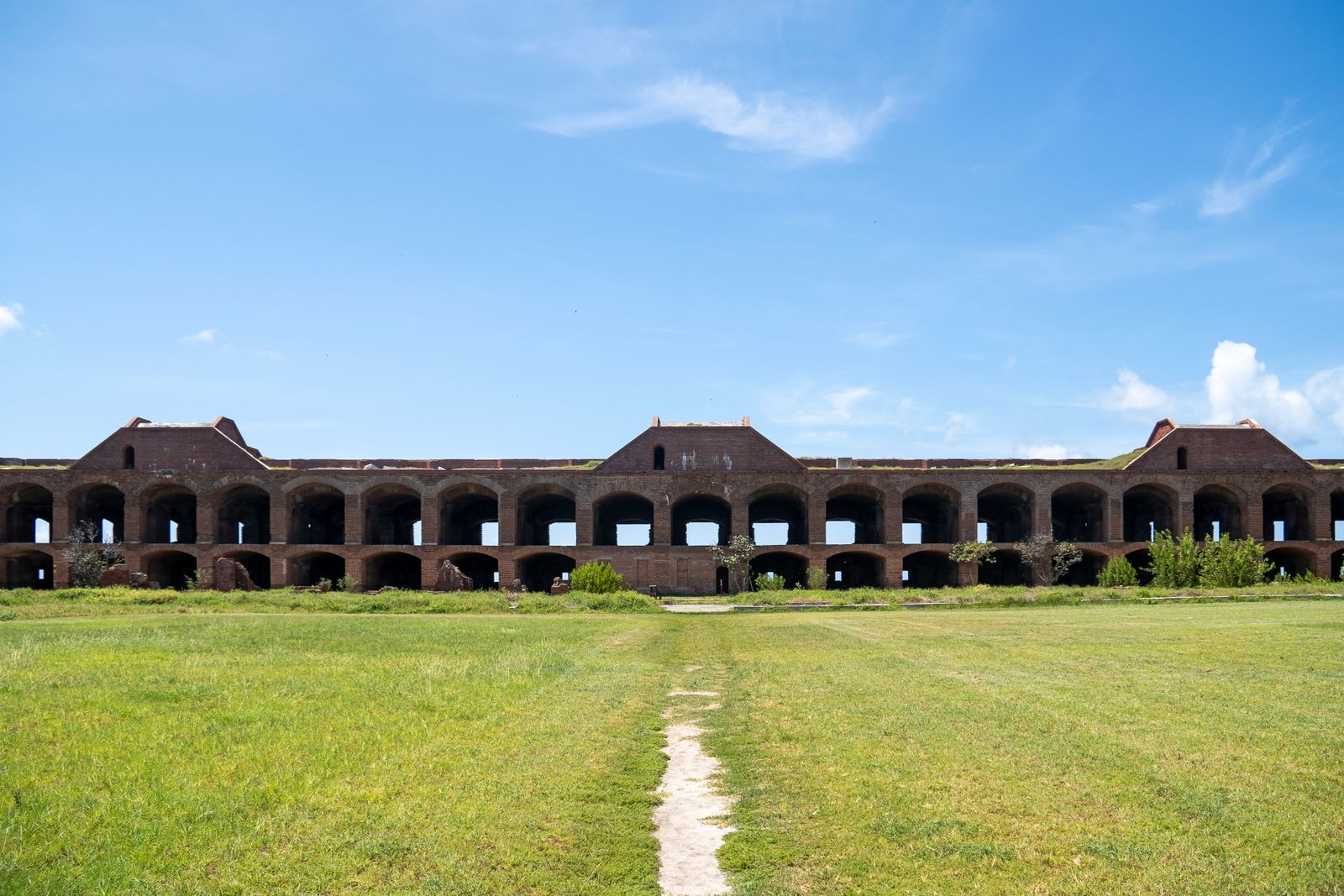
Fort Jefferson — Dry Tortugas · est. 1846 · Civil War. The remote island giant, accessible by ferry or seaplane from Key West.
All 66 Florida sites are on the Florida forts page.
What Should You Know Before Visiting a Public Fort?
- "Open to the public" doesn't always mean staffed. Some sites are preserved earthworks or ruins in open parkland — you can walk them anytime, but there's no visitor center. Others are full museums with admission fees and set hours.
- National park sites and state parks have different fee systems. An America the Beautiful pass covers the federal sites; state parks charge separately.
- Island forts need planning. Sumter, Jefferson, and Matanzas all require boats. Matanzas is free; the others should be booked ahead in season.
- Confirm current hours. The National Park Service and state park websites carry official schedules, and every fort page in this directory notes current status.
This list is a starting point, not the full picture — hundreds more publicly accessible forts are cataloged state by state. If you want the greatest hits first, see the most popular historic forts to visit; otherwise pick your region, open the state page, and see what's within a day's reach.