Fort Randall Army Airfield (Cold Bay, Alaska)
Cold Bay · Alaska · World War II
History & Significance
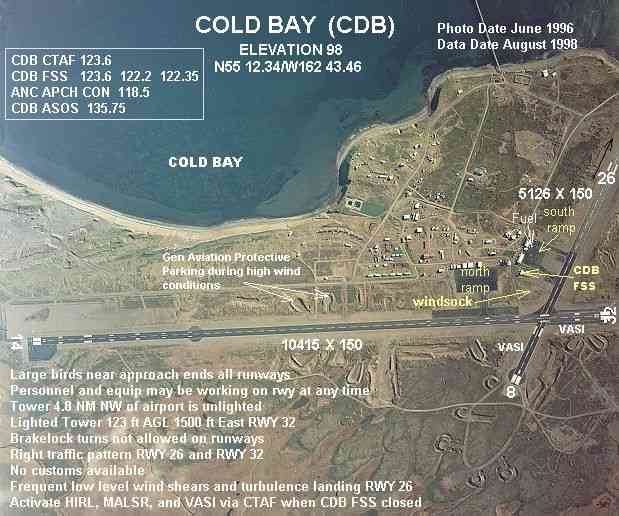
Disguised as civilian employees of the Blair Canning and Packing Company, Army personnel in civilian clothes began construction in December 1941, completing the airfield by March 1942. The new airfield at Cold Bay, along with a companion secret airfield on Umnak, was ready to defend Alaska against Japanese air attack during the Battle of Dutch Harbor in June 1942.
Fort Randall included extensive fuel storage, piping systems, docking facilities, and troop quarters along with the airfield. By June 1, 1942, approximately 13,000 troops were stationed at Cold Bay.
As the war in the Aleutians moved westward in 1942–1943, Cold Bay and Dutch Harbor declined in strategic value, and by March 1945 facilities were abandoned and in disrepair. Southeast of the Army airbase lay "Navy Town," which included a dispersed hospital complex of Quonset huts connected by wood-frame corridors that became a standard design for Aleutian installations.
In 1945, Cold Bay served as the site of Project Hula, transferring 149 ships and training 12,000 Soviet personnel in anticipation of Soviet entry against Japan. The facility was redesignated from Army Air Base to Air Force Base on March 28, 1948.
The base closed on September 1, 1953, due to Korean War transport demands that subsequently ceased. By 1950, Fort Randall was closed and abandoned.
Key Facts
Map
View larger map ↗ · © OpenStreetMap contributors
🧳 Visiting
Sources
- https://www.loc.gov/item/ak0207/
- https://en.wikipedia.org/wiki/Thornbrough_Air_Force_Base
- https://www.poa.usace.army.mil/Portals/34/docs/civilworks/publicreview/ColdBayFUDSEAFONSIOct2013.pdf
- https://www.nps.gov/articles/wwii-nhl-aleu-campaign.htm
- https://en.wikipedia.org/wiki/Aleutian_Islands_campaign