Fort Wicked (Merino, Colorado)
Merino · Colorado · Colorado War
History & Significance
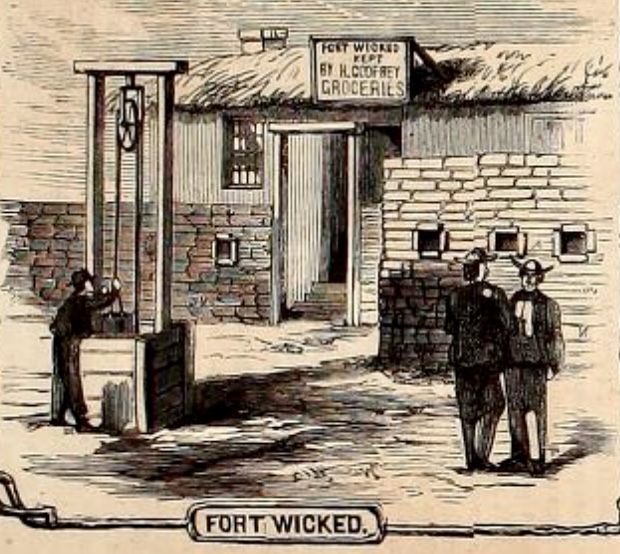
After the Overland Stage Route was established along the South Platte Trail in 1862, Holon Godfrey and his wife Matilda operated a stage station, rest stop, and general store. Godfrey was also a blacksmith who conditioned road-weary horses for travelers.
In 1864, heightened threat of Indigenous attack led Godfrey to fortify his ranch with gun ports in adobe brick walls, a lookout tower, and a six-foot perimeter wall. On January 14–15, 1865, about 100 Indigenous warriors attacked Godfrey's homestead in a reprisal campaign following the Sand Creek Massacre of November 1864.
Warriors attacked while defenders returned fire from gun ports; attackers set surrounding grass ablaze, which Godfrey extinguished with water buckets; the battle lasted from night until morning. Godfrey's ranch was one of the few ranches to survive the January 1865 attacks.
After the successful defense, Godfrey christened his property "Fort Wicked." The Godfreys departed around 1868 when the Union Pacific Railroad reached Cheyenne, Wyoming. A state historical marker was erected in 1929 by the Colorado State Historical Society and the Sterling Chamber of Commerce.
Key Facts
Map
View larger map ↗ · © OpenStreetMap contributors
🧳 Visiting
What you’ll see when you visit:
- Historical marker commemorating the 1865 Indian raid defense
- Overland Trail stage station site in northeastern Colorado plains
- Colorado War era settlement on Lakota, Cheyenne, and Arapaho homelands
- Holon Godfrey family's fortified ranch stand against tribal warriors
Sources
- https://en.wikipedia.org/wiki/Fort_Wicked
- https://www.hmdb.org/m.asp?m=61998
- https://coloradoencyclopedia.org/keyword/fort-wicked
- https://coloradoencyclopedia.org/image/fort-wicked-historical-marker
- https://en.wikipedia.org/wiki/Raid_on_Godfrey_Ranch
- https://northamericanforts.com/West/co.html